
Mainframe Modernization Approaches
Modernizing Mainframe Applications for the Digital Enterprise
- Tracey Wilson
- August 20, 2026
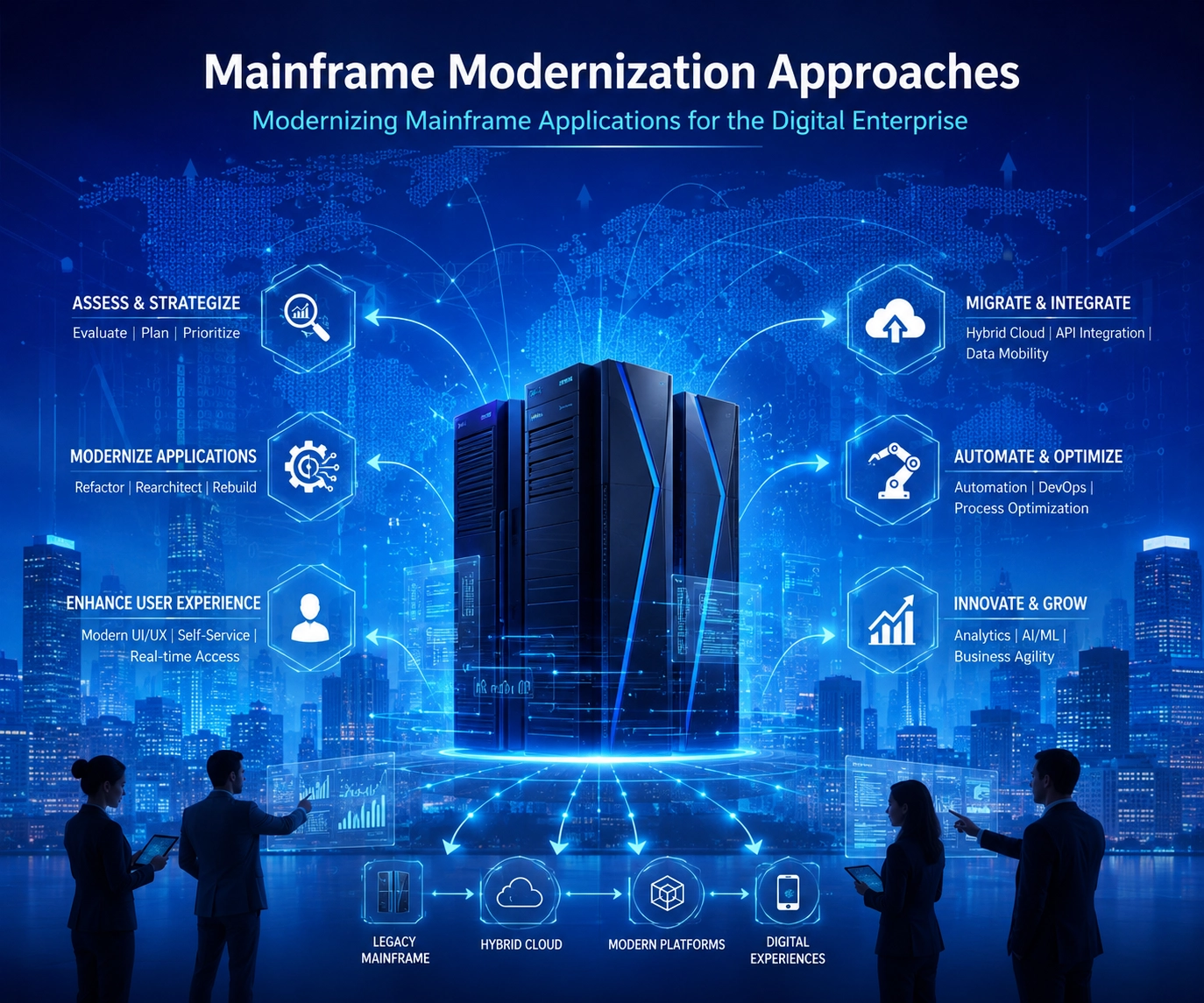
Mainframes continue to power some of the world’s most critical business operations across banking, insurance, retail, healthcare, manufacturing, telecommunications, and government sectors. Enterprises rely on mainframe systems because of their reliability, security, scalability, and unmatched transaction-processing capabilities.
Even today, core business applications running on IBM Z environments process millions of business transactions every day with exceptional stability and performance.
However, modern businesses require faster innovation, digital integration, cloud connectivity, API-driven services, real-time analytics, and improved user experiences. Many organizations are now looking for ways to modernize their mainframe environments while continuing to leverage the stability and strength of existing systems.
Mainframe modernization is not about replacing the platform entirely. It is about transforming applications, processes, interfaces, and integration capabilities to support modern business requirements while preserving critical business logic.
A successful modernization strategy helps organizations improve agility, reduce operational complexity, enable digital transformation, and extend the value of existing mainframe investments.
Why Mainframe Modernization is Important
Traditional mainframe environments were designed for highly reliable transaction processing and batch operations. While these systems remain extremely effective, organizations today face new business and technology demands.
Common Challenges in Legacy Mainframe Environments
- Green-screen terminal interfaces
- Monolithic COBOL applications
- Limited API integration capabilities
- Batch-oriented processing models
- Slow release cycles
- Skill gap challenges
- Difficulty integrating with cloud and modern platforms
- Increasing demand for real-time business services
Modern enterprises require:
- Web and mobile accessibility
- API-driven integration
- Faster application delivery
- Real-time data access
- Cloud connectivity
- Improved customer experience
- Better analytics and visibility
- Agile development practices
Mainframe modernization helps organizations bridge the gap between stable legacy systems and modern digital business expectations.
Key Mainframe Modernization Approaches
There is no single modernization strategy suitable for every organization. The right approach depends on:
- Business priorities
- Application complexity
- Compliance requirements
- Budget and timelines
- Existing technology landscape
- Long-term digital transformation goals
The following are the most common and effective mainframe modernization approaches.
1. UI Modernization
Many traditional mainframe applications still rely on green-screen interfaces such as 3270 terminals.
UI modernization focuses on improving user experience without changing core business logic.
Objectives of UI Modernization
- Improve usability
- Enable browser access
- Support mobile accessibility
- Reduce training effort
- Improve operational productivity
- Deliver modern dashboards and workflows
UI Modernization Approaches
Organizations can modernize mainframe user interfaces using:
- Web-based frontends
- Terminal modernization tools
- Responsive browser applications
- Dashboard and reporting interfaces
- Employee self-service portals
Benefits of UI Modernization
- Improved user experience
- Faster onboarding for new users
- Better accessibility
- Increased operational efficiency
- Reduced dependency on legacy terminal environments
UI modernization is often the fastest way to deliver visible business value.
VRXzGit for Automated Mainframe Migration
Modern mainframe transformation initiatives increasingly require automation to reduce migration effort, improve delivery speed, and minimize operational risk.
VRXzGit is designed to support automated mainframe modernization and migration initiatives by helping organizations streamline application analysis, migration workflows, code management, and modernization activities.
How VRXzGit Supports Mainframe Modernization
Automated Migration Support
VRXzGit helps accelerate modernization programs through automated migration processes and structured transformation workflows.
Source Code Management and Version Control
Traditional mainframe environments often rely on manual or legacy change management processes. VRXzGit enables better code governance, version control, and modernization lifecycle management.
Application Analysis and Dependency Visibility
Understanding application dependencies is one of the biggest challenges during modernization. VRXzGit helps organizations analyze:
- Program dependencies
- Batch relationships
- JCL workflows
- Impact analysis
- Application structure
DevOps Enablement
VRXzGit supports modernization initiatives by enabling:
- Automated deployment workflows
- CI/CD integration
- Structured release management
- Better collaboration between teams
Reduced Migration Risk
Automation reduces manual effort and improves consistency across modernization and migration projects.
Benefits of Using VRXzGit
- Faster modernization execution
- Reduced manual effort
- Improved visibility into application dependencies
- Better governance and version control
- Improved delivery efficiency
- Reduced operational risk
- Support for enterprise modernization initiatives
Organizations modernizing large mainframe environments can use VRXzGit as part of their broader modernization and transformation strategy.
2. Application Modernization
Many mainframe applications are built using legacy technologies such as COBOL, PL/I, JCL, CICS, IMS, and batch processing systems.
Application modernization focuses on improving maintainability, scalability, and agility.
Common Application Modernization Activities
- Refactoring COBOL applications
- Modularizing monolithic programs
- Improving code structure
- Enhancing batch workflows
- Separating business logic from presentation logic
- Introducing reusable services
Benefits of Application Modernization
Improved Maintainability
Modernized applications are easier to support and enhance.
Faster Development Cycles
Modular architectures improve agility.
Reduced Technical Debt
Refactoring improves long-term sustainability.
Better Integration Capability
Reusable business services simplify enterprise integration.
Application modernization creates a strong foundation for API enablement and cloud integration.
3. API Enablement and Integration Modernization
Modern enterprises require applications to interact seamlessly with digital platforms, cloud services, mobile applications, and enterprise systems.
Traditional mainframe applications were not originally designed for modern API-driven integration.
API modernization enables organizations to expose mainframe business services securely and efficiently.
API Modernization Strategy
Step 1: Identify Reusable Business Functions
Typical API candidates include:
- Customer services
- Account processing
- Claims processing
- Payment services
- Inventory validation
- Order processing
- Shipment tracking
Step 2: Refactor Business Logic
Business logic is separated into reusable services.
Step 3: Expose APIs
Applications are exposed through:
- REST APIs
- JSON services
- Microservices
- Enterprise integration layers
Step 4: Integrate Enterprise Platforms
Mainframe systems integrate with:
- Mobile applications
- Customer portals
- Cloud platforms
- CRM and ERP systems
- Analytics tools
- Third-party services
Benefits of API Enablement
- Faster integrations
- Real-time business services
- Improved customer experience
- Better enterprise connectivity
- Support for digital transformation initiatives
API enablement allows mainframe applications to become active participants in modern enterprise ecosystems.
4. Data and Database Modernization
Mainframe environments often contain highly valuable enterprise data accumulated over decades.
Data modernization focuses on improving accessibility, reporting, analytics, and integration.
Common Data Modernization Activities
- Data virtualization
- Real-time data access
- Data replication
- Analytics integration
- Modern reporting enablement
- Enterprise data integration
Benefits of Data Modernization
Improved Business Visibility
Organizations gain better access to operational and analytical insights.
Faster Reporting
Modern analytics tools integrate more efficiently.
Better Data Accessibility
Enterprise applications can securely access critical business data.
Support for AI and Analytics
Modernized data platforms support advanced analytics initiatives.
Data modernization is essential for organizations pursuing data-driven business strategies.
5. Cloud Integration and Hybrid Modernization
Many organizations want to integrate mainframe systems with cloud platforms without moving core workloads entirely off the mainframe.
Hybrid modernization enables organizations to combine the reliability of mainframes with the flexibility of cloud services.
Common Cloud Integration Areas
- API integration
- Hybrid application environments
- Cloud analytics
- Event-driven integration
- SaaS connectivity
- Data synchronization
Benefits of Hybrid Modernization
- Improved scalability
- Faster innovation
- Better business agility
- Reduced infrastructure complexity
- Support for modern application ecosystems
Most enterprises adopt hybrid strategies that preserve core transaction processing on the mainframe while enabling cloud-based innovation.
6. DevOps and Delivery Modernization
Modern software delivery requires automation, faster deployment cycles, and better collaboration between development and operations teams.
Traditional mainframe environments often rely on manual deployment and slower release processes.
DevOps Modernization Includes
- Source control implementation
- Automated build and deployment
- CI/CD pipelines
- Automated testing
- Release management modernization
- Workflow automation
Benefits of DevOps Modernization
- Faster release cycles
- Improved quality and stability
- Reduced deployment risk
- Better collaboration
- Increased development productivity
DevOps modernization helps mainframe teams align with enterprise agile delivery standards.
7. Mainframe Cost Optimization
Organizations are increasingly focused on optimizing operational costs while continuing to leverage mainframe capabilities.
Cost optimization modernization focuses on improving efficiency, resource utilization, and software visibility.
Common Optimization Areas
- Workload optimization
- Software usage analysis
- Capacity planning
- Automation initiatives
- Batch optimization
- License optimization
Benefits of Cost Optimization
- Reduced operational expenses
- Better resource utilization
- Improved visibility into software usage
- Enhanced infrastructure efficiency
- Better long-term scalability
Optimization initiatives help organizations maximize the value of existing mainframe investments.
Choosing the Right Mainframe Modernization Strategy
The right modernization approach depends on business objectives and technical priorities.
When to Focus on UI Modernization
Choose UI modernization when:
- Users struggle with green-screen interfaces
- Browser access is required
- Employee productivity needs improvement
- Faster onboarding is needed
When to Focus on API Enablement
Choose API modernization when:
- Enterprise integrations are expanding
- Mobile applications need mainframe data
- Real-time business services are required
- Cloud integration initiatives are growing
When to Focus on Application Refactoring
Choose application modernization when:
- Applications are difficult to maintain
- Technical debt is increasing
- Development agility is limited
- Long-term scalability is needed
When to Focus on Data Modernization
Choose data modernization when:
- Analytics initiatives are expanding
- Real-time reporting is required
- Enterprise data integration is growing
- AI and data-driven initiatives are increasing
Most successful modernization programs combine multiple approaches in phases.
Recommended Mainframe Modernization Roadmap
A practical modernization roadmap often includes:
Phase | Modernization Focus |
Phase 1 | Application and infrastructure assessment |
Phase 2 | UI modernization |
Phase 3 | Application refactoring |
Phase 4 | API enablement and integration |
Phase 5 | Data modernization and analytics |
Phase 6 | DevOps and cloud integration |
Phase 7 | Optimization and automation |
A phased strategy helps organizations reduce risk while delivering measurable business value.
Benefits of Mainframe Modernization
Organizations modernizing their mainframe environments typically achieve significant business and operational improvements.
Improved Business Agility
Modernized systems support faster business innovation.
Better User Experience
Modern interfaces improve productivity and usability.
Faster Integration Capability
APIs simplify enterprise connectivity.
Enhanced Operational Efficiency
Automation and modernization reduce manual effort.
Reduced Risk
Incremental modernization preserves stable business operations.
Extended System Lifespan
Modernization protects decades of business investment.
Improved Scalability
Modern architectures support future business growth.
Conclusion
Mainframe modernization is not about abandoning the mainframe platform. It is about transforming existing systems to support modern business requirements while preserving the reliability, scalability, and strength of core applications.
Successful modernization strategies focus on:
- UI modernization
- Application refactoring
- API enablement
- Data modernization
- Cloud integration
- DevOps transformation
- Operational optimization
Organizations that modernize strategically can continue leveraging the power of mainframes while enabling digital transformation, faster innovation, improved user experiences, and enterprise integration.
A well-planned modernization roadmap helps enterprises reduce risk, improve agility, optimize operational efficiency, and extend the long-term value of their mainframe investments.
With the right approach, mainframe systems can continue serving as a critical foundation for enterprise digital transformation for many years to come.